Skip to content

Budock Parish Council

Welcome to the Budock Parish Council website

Budock Parish Council serves the communities of Budock Water, Treverva and Lamanva in south-west Cornwall, close to the harbour town of Falmouth.

With its distinctive villages, beautiful surrounding countryside and rich local heritage, Budock is a parish with a character and identity of its own.

This website provides information about the work of the Parish Council, including council meetings, local services, community projects and the care of our local environment.

Whether you live, work or spend time in the parish, or are simply interested in learning more about Budock, we hope you find the information you need and enjoy discovering more about our parish and its communities.

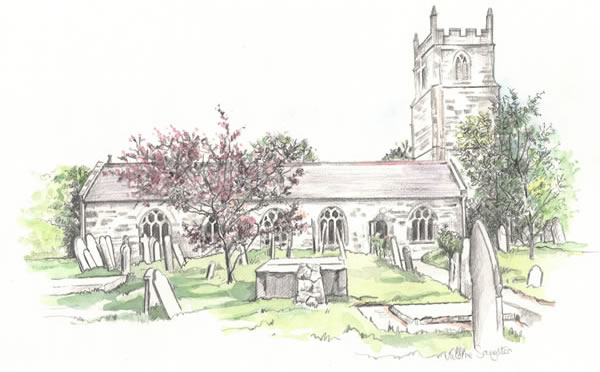
Sketch of Budock Church showing its tower, church building, surrounding trees and gravestones

Illustration of the church at Budock, drawn by local resident Valerie Sangster.

A Parish with a long history

Budock is an ancient parish in south-west Cornwall, close to Falmouth and Penryn. Its history stretches back many centuries, long before either neighbouring town developed into the places we know today. The parish is recorded in the Domesday Book of 1085, and the earliest recorded rector of Budock was John de Plesseto in 1207.

For centuries, St Budock's Church stood at the heart of a much larger ecclesiastical parish, historically associated with Falmouth, Penryn and St Gluvias.The church remains an important landmark and a reminder of the parish's long history. Parts of the building date from the 13th century, while significant features, including the tower, reflect its later medieval development.

From the Parish Archives

An old Budock Vestry Register contains a description of the parish boundary dated 24 May 1677. Written in the language and spelling of its time, the record traces the boundary through lanes, rocks, streams and named places, offering a fascinating glimpse into how the parish was understood more than three centuries ago. The original entry reads:

"West from Mainporth to Penwarne, to a rocke that lyes in the lane northwards from the white wall, and from thence to a rocke in Troune Moore, which lyes between Constanton, Mawnon and Budocke, from thence to an old lane which joins with Rosecolas, from thence to a river that comes from James Davas, his mills called Anter Water, which devids Budocke and Mabe, and from thence to the Colledge".

This historical description reflects a time when parish boundaries were identified through familiar landmarks, tracks and natural features rather than modern maps. The historic parish once included land that later became part of neighbouring settlements. In 1661, Falmouth was separated from Budock Parish, and further boundary changes followed over the centuries. In 1934, the Ponsharden and Glasney area became part of Penryn.

Budock Parish today

Today, the civil parish of Budock covers approximately 2,388 acres and had a population of 1,684 at the 2021 Census. Situated close to Falmouth, the parish shares boundaries with neighbouring communities including Mabe, Penryn, Mawnan and Constantine. Budock Water lies near the centre of the parish, while Treverva and Lamanva are smaller settlements to the west. Although the parish has changed over time, its villages, countryside and historic church continue to give it a distinctive local identity.

Budock Water

Nestled in the shelter of Trewen Downs, Budock Water is surrounded by greenery and the gentle landscape of the Cornish countryside. A stream runs beneath the main road and continues towards the coast at Maenporth.

St Budock's Church stands a short distance from the village centre, reached along Churchtown. Its historic building and churchyard remain important features of the parish. The village has a strong community identity, with its village hall, general store and Trelowarren Arms among its familiar landmarks. Outside the public house, the site of the former village pump is now marked by a small garden and seating area.

Treverva

Treverva is a small village in the western part of the parish. Its origins are thought to lie in a farmstead and its associated workers' cottages, which developed into a settlement around a road junction.

The village has strong links with Cornwall's granite-working heritage. Quarrying once provided employment for local people, and granite was transported by horse towards Freeman's Wharf in Penryn, where it could be shipped onwards.

The surrounding landscape changed significantly with the creation of Argal Reservoir in the valley between Treverva and Mabe. Today, the reservoir and its surroundings form a distinctive feature of the local countryside, with views across the water from roads near the village.

Lamanva

Lamanva is a small settlement to the west of Budock Water, with origins thought to be associated with an early farmstead.

Like other settlements in the parish, Lamanva has links to Cornwall's quarrying past. A granite quarry once operated in the area, and the village is also remembered for its former drovers' inn, which served people travelling with livestock.

Though small, Lamanva forms an important part of Budock Parish's wider story, reflecting the rural life, work and traditions that have shaped these communities over generations.